

-
1 тип базисног
General subject: basic function block type: a function block type which cannot be decomposed into other function blocks and which utilizes an execution control chart ( ECC) to control the execution of its algorithms (см. IEC 61499-1) -
2 тип базисного функционального блока
Programming: basic function block type (см. IEC 61499-1)Универсальный русско-английский словарь > тип базисного функционального блока
-
3 forma
f.1 shape, form (figura).en forma de in the shape ofen forma de L L-shapedtener forma ovalada o de óvalo to be oval in shape2 way, manner (manera).se puede hacer de varias formas it can be done in several different ways¡qué forma de llover! it's absolutely pouring down!de cualquier forma, de todas formas anyway, in any casede esta forma in this wayforma de pago method of paymentforma de ser: es su forma de ser that's just the way he is3 form.la fotografía es una forma de arte photography is an art formformas de vida life forms4 form (no fondo).forma y fondo form and content5 host (religion).6 form (formulario). (Mexican Spanish)7 kind, form.8 aspect, semblance, appearance.9 cast.pres.indicat.3rd person singular (él/ella/ello) present indicative of spanish verb: formar.imperat.2nd person singular (tú) Imperative of Spanish verb: formar.* * *1 (gen) form, shape2 (manera) way3 DEPORTE form1 (modales) manners, social conventions2 familiar (de mujer) curves\de esta forma in this wayde forma que so thatde todas formas anyway, in any caseestar en baja forma to be off formestar en forma to be in shape, be fitponerse en forma to get fitbuenas formas good mannersforma de pago method of paymentforma física physical fitnessla Sagrada Forma the Host* * *noun f.1) form, shape2) manner, way•* * *SF1) (=figura) shape•
nubes de humo con forma de hongo — mushroom-shaped clouds of smokequiso dar forma literaria a sus teorías filosóficas — he wanted to put his philosophical theories into literary form
•
en forma de U — U-shaped•
tomar forma — to take shape2) (=modo) waysolo conozco una forma llegar hasta allí — I only know one way of getting there o one way to get there
•
de forma directa/inmediata/natural — directly/immediately/naturallyel plan entrará en vigor de forma inmediata — the plan will take immediate effect, the plan will take effect immediately
queremos controlar los costes y, de esta forma, evitar reducir la plantilla — we want to bring down costs and thus avoid having to downsize
•
de todas formas — anyway, in any casepero de todas formas te agradezco que me lo hayas dicho — but thank you for letting me know anyway, but in any case thank you for letting me know
forma de pago — method of payment, form of payment
forma de ser, es mi forma de ser — that's how I am, that's the way I am
3)• de forma que — (=en un modo que) in such a way as, so as; (=por eso) so that
él intentó contestar la pregunta de forma que no le comprometiese — he tried to answer the question so as o in such a way as not to commit himself
el número de socios fue creciendo cada año, de forma que en 1989 eran ya varios miles — the number of members grew every year, so that o such that by 1989 there were several thousand
•
de tal forma que — (=en un modo que) in such a way that; (=tanto que) so much that; (=por eso) so thatla noticia se filtró de tal forma que fueron incapaces de evitarlo — news leaked out in such a way that they were unable to stop it
la empresa ha crecido de tal forma que es irreconocible — the company has grown so much o to such an extent that it is unrecognizable
su padre era italiano y su madre polaca, de tal forma que él siempre se ha sentido europeo — his father was Italian and his mother Polish, so (that) he has always felt himself to be European
4) (tb: forma física) fitness, formel jugador ha recuperado su forma física — the player is fit again, the player has regained fitness o form
•
estar en (buena) forma — [para hacer deporte] to be fit, be in good shape; [para realizar otra actividad] to be in (good) formestar en baja forma — (lit) to be not fully fit; (fig) to be in bad shape
5) (=aspecto externo) formes pura forma — it's just for the sake of form, it's a mere formality
•
defecto de forma — (Jur) technicality7) pl formas [sociales] appearances8) (Rel)•
la Sagrada Forma — the Host9) (=molde) (Téc) mould, mold (EEUU); [de zapatero] last; [de sombrero] hatter's block; (Tip) forme, form (EEUU)10) (Ling) [del verbo] form11) (Tip) (=formato) format12) LAm*•
en forma, una fiesta en forma — a proper party, a blowout *va a celebrar su cumpleaños en forma — he's going to have a proper o a serious * birthday party
13) Méx formsee MANERA, FORMA, MODO* * *1)a) (contorno, apariencia) shapedar forma a algo — ( al barro) to shape something; ( a proyecto) to give shape to something
el suéter ha tomado la forma de la percha — the sweater's been stretched out of shape by the coat hanger
b) (tipo, modalidad) formla discriminación no se tolerará bajo ninguna de sus formas — discrimination will not be tolerated in any shape or form
2) (Lit) (de una novela, obra) form; (Fil) form3) (Ling) form4) (Dep, Med)estar/mantenerse en forma — to be/keep fit
en forma — (AmL fam)
una comida en forma — a good square meal (colloq)
nos divertimos en forma — (AmL fam) we had a really good time
5) (manera, modo) wayde forma que — (frml) in such a way that
de cualquier forma or de todas formas — anyway, in any case
6) formas femenino plurala) ( de mujer) figureb) ( apariencias) appearances (pl)7) (Méx) ( formulario) form* * *= approach [approaches, -pl.], form, guise, means, mode, shape, way, mould [mold, -USA], shaping, complexion, manner, fashion.Ex. During the last twenty years the variety of approaches to the organisation of knowledge has proliferated with the introduction of computer-based methods.Ex. It is under the chosen form of heading that the catalogue entry for a particular document is filed and hence located.Ex. In various guises, the basic concepts have found application in the design of a number of special classification schemes.Ex. The easiest means of illustrating some of the foregoing points is to introduce in outline some special classification schemes.Ex. Various modes of operation are possible for such a journal, and the precise operation will depend upon the type of information being conveyed.Ex. If the book has an unusual shape then both the height and the width of the book will be given.Ex. They are likely to influence the future function of DC, and the way in which the scheme will evolve, but since there will be a continuing need for shelf arrangement, DC will remain necessary.Ex. The two moulds, which were twins, were oblong wire sieves mounted on wooden frames, and the deckle was a removable wooden rim which could be fitted to either mould to make it into a tray-like sieve with a raised edge.Ex. The process of shaping the scientific and technical propaganda into a legitimate specialisation is described.Ex. These documents contain the Commission's sentiments on how policy should be evolved in particular sectors and what complexion it should take = Estos documentos contienen el sentir de la Comisión de cómo debería desarrollarse la política en sectores concretos y qué cariz debería tomar.Ex. City planning is a body of techniques and theories for co-ordinative decision-making which tries to distribute the community's resources in a manner which will best achieve the community's specific goals, whatever they may be = El urbanismo es un conjunto de técnicas y teorías para la toma coordinada de decisiones que intenta distribuir los recursos de la comunidad de tal forma que se consigan mejor los objetivos específicos de ésta, sean cuales sean.Ex. It was on the tip of his tongue to say: 'Must you speak to me in this uncivilized fashion?' But he discreetly forbore.----* acabar de forma positiva = end + Nombre + on a high (note).* actuar de forma negligente = be remiss.* adoptar forma = take + shape.* adoptar la forma de = take + form, take + the form of, come in + the form of.* aprender de la forma más difícil = learn + the hard way.* asumir una forma = assume + form.* botón en forma de palo = toggle fastener.* buena forma física = fitness, physical fitness.* buscar la forma de = look for + ways to.* buscar la forma de + Infinitivo = develop + way of + Gerundio.* buscar una forma de hacer (algo) = develop + way + to make + Nombre.* caer en forma de cascada = cascade.* cambiar de forma = shape-shift.* cambiar de forma de vivir = turn + Posesivo + life around.* catálogo encuadernado en forma de listado de ordenador = computer book form catalogue.* catálogo en forma de álbum = guard (book) catalogue.* catálogo en forma de libro = bookform catalogue, book catalogue.* catálogo en forma de libro encuadernado = bound book form catalogue.* catálogo en forma de listado = computer print-out catalogue.* catálogo en forma de listado de ordenador = computer book form catalogue.* catálogo impreso en forma de libro = printed book catalogue.* como forma de vida = as a way of life.* como una forma de = as a means of.* concepto de forma = form concept.* con forma de castillo = castellated.* con forma de estrella = star-shaped [star shaped].* con forma de pelo = hair-like.* con forma de pera = pear-shaped.* con forma de pirámide = trihedral, pyramidal-shaped.* con forma de tetraedro = trihedral.* con forma de U = U-shaped.* con forma piramidal = pyramidal-shaped.* dar cuerpo y forma a = lend + substance and form to.* dar forma = become + cast, give + shape, shape, mould [mold, -USA], inform.* dar nueva forma = reformat [re-format].* de alguna forma = in one way or another, one way or another.* de alguna otra forma = in any other way.* de cualquier forma = in any event, in any way [in anyway], in any case, in any way at all.* de cualquier forma posible = in any and all ways.* de esta forma = in this fashion, in this manner, in this way.* de forma = in form.* de forma abrumadora = overwhelmingly.* de forma aceptable = adequately, acceptably.* de forma adecuada = adequately, appropriately.* de forma alternada = in alternating fashion.* de forma alternativa = alternatively.* de forma anónima = anonymously.* de forma aplastante = overwhelmingly.* de forma apreciable = markedly.* de forma apropiada = properly, fitly, appropriately.* de forma audible = audibly.* de forma autónoma = autonomously.* de forma caprichosa = capriciously.* de forma clara = clearly.* de forma colegiada = collegially.* de forma combinada = in combination.* de forma competitiva = competitively.* de forma complementaria = complimentarily.* de forma completa = in full.* de forma conjunta con = in partnership with.* de forma considerable = considerably.* de forma continuada = continuously.* de forma cuadrada = squarish, square-shaped.* de forma deductiva = deductively.* de forma desastrosa = disastrously.* de forma deshonesta = dishonestly.* de forma diferente = differently shaped.* de forma digital = digitally.* de forma divertida = funnily.* de forma económica = cost-effectively.* de forma errática = erratically.* de forma escandalosa = outrageously.* de forma especulativa = speculatively.* de forma estructurada = in a structured fashion.* de forma exquisita = exquisitely.* de forma extraña = oddly, funnily.* de forma federal = federally.* de forma general = widely, bulk.* de forma global = holistically.* de forma graciosa = funnily.* de forma gratis = on a complimentary basis.* de forma gratuita = on a complimentary basis.* de forma grotesca = grotesquely.* de forma heterogénea = heterogeneously [heterogenously].* de forma heurística = heuristically.* de forma humorística = in a humorous vein.* de forma imaginativa = imaginatively.* de forma indirecta = circuitous route.* de forma inesperada = like a bolt out of the blue, like a bolt from the blue.* de forma innata = innately.* de forma irregular = erratically.* de forma lamentable = miserably.* de forma lógica = in a meaningful way.* de forma mágica = magically.* de forma mecánica = mechanically.* de forma mordaz = pungently.* de forma muy parecida a = in much the same way as.* de forma muy similar a = in much the same way as.* de forma negativa = in a negative light.* de forma neutral = neutrally.* de forma notoria = markedly.* de forma óptima = optimally.* de forma personalizada = on a one-to-one basis.* de forma poco ética = unethically.* de forma poco imaginativa = unimaginatively.* de forma poco profesional = unprofessionally.* de forma poco razonable = unreasonably.* de forma positiva = in a positive light, constructively.* de forma práctica = pragmatically.* de forma precisa = precisely.* de forma puntual = occasionally, when necessary.* de forma que = in ways that.* de forma que resulta más fácil de entender = in digestible form.* de forma rara = oddly, funnily.* de forma recíproca = reciprocally.* de forma regular = regularly.* de forma rentable = cost-effectively.* de forma ridícula = grotesquely.* de forma saludable = healthily.* de forma sana = healthily.* de forma significativa = to any significant extent, to a significant extent.* de forma sistemática = in a systematic fashion.* de forma sofisticada = sophisticatedly.* de forma subconsciente = subconsciously.* de forma sublime = subliminally.* de forma suscinta = in brief.* de forma terapéutica = therapeutically.* de forma tosca = in crude form.* de forma trágica = tragically.* de igual forma = in like manner, in a like manner, in like fashion, in like vein.* de la forma más difícil = the hard way.* de la forma más fácil = the easy way .* de la mejor forma posible = to the best of + Posesivo + ability.* de la misma forma que = in the same way (as), in the same manner (as), in much the same way as.* de la otra forma = the other way (a)round.* de muchas formas = in more ways than one.* de ninguna forma = in any way at all.* de ninguna otra forma = in any other way.* de nuevas formas = in new ways.* de otra forma = in any other way.* describir de forma general = outline.* de tal forma que + ser/estar = in such form as to + be.* de todas formas = anyway(s), at any rate, anyhow.* de todas las formas posibles = in any and all ways.* de una forma = in a fashion.* de una forma + Adjetivo = in + Adjetivo + manner.* de una forma ambigua = ambiguously.* de una forma brillante = brilliantly.* de una forma deplorable = execrably.* de una forma fácil = easily.* de una forma hábil = skilfully [skillfully, -USA].* de una forma intangible = intangibly.* de una forma lógica = logically.* de una forma monstruosa = monstrously.* de una forma organizada = in an organised fashion.* de una forma rápida = quickly.* de una forma relativamente + Nombre = relatively + Adverbio.* de una forma simple = in a simple manner, simply.* de una forma tautológica = tautologically.* de una forma u otra = in some form or other, in one way or another, one way or another, in one form or another.* de una nueva forma = in a new way.* dispuesto de forma uniforme = regimented.* división de forma = form division.* edificio en forma de cubo = cubic building.* en buena forma = in good nick.* encabezamiento de forma = form heading.* encontrar la forma de = devise + ways.* en forma = fit [fitter -comp., fittest -sup.], toned.* en forma de = in the form of, in the shape of.* en forma de A = A-shaped.* en forma de arco = arched, bowed.* en forma de capa = cape-like.* en forma de cruz = cross-shaped.* en forma de cuadrado = square-shaped.* en forma de cuña = wedge-shaped.* en forma de cúpula = dome-shaped, domed.* en forma de D = d-shaped.* en forma de estrella = star-shaped [star shaped].* en forma de libro = in book form.* en forma de medialuna = crescent-shaped.* en forma de parásito = parasitically.* en forma de pera = pear-shaped.* en forma de pirámide = pyramidal-shaped.* en forma de trompeta = trumpet-shaped.* en forma de U = U-shaped.* en forma de V = V-shaped.* en forma física = physically fit.* en forma física y mental = physically and mentally fit.* en forma ovalada = oval-shaped.* en forma piramidal = pyramidal-shaped.* en mala forma = in bad nick.* en plena forma = in peak condition, in tip-top form, in tip-top condition.* en su forma más básica = at its most basic.* entintar la forma = beat + the forme.* entrada de forma = form entry.* estar en forma = be in shape, be in good shape.* estar ordenado en forma circular = be on a wheel.* faceta de forma = Form facet.* forma adjetival = adjectival form.* forma artística = art form.* forma de actuar = discourse.* forma de comportamiento = mode of behaviour, way of conduct.* forma de conducta = mode of conduct, way of conduct.* forma de conseguir algo = lever.* forma de doble fondo = double-faced mould.* forma de escribir = writing style.* forma de evitar Algo = way round + Algo.* forma de evitar una dificultad = way (a)round + difficulty.* forma de evitar un problema = way round + problem.* forma de expresión = way of expression, mode of expression.* forma de funcionar = business model.* forma de hablar = manner of speaking.* forma de hacer papel = paper mould.* forma de impresión = composing frame, forme, plate, frame.* forma de la curva estadística en su valor más alto = peak-shape.* forma de pago = form of payment.* forma de papel vitela = wove mould.* forma de pensar = thinking, belief system, set of opinions, mode of thought, mode of thinking.* forma de presentación = form of presentation.* forma de trabajar = working practice, work practice, business model.* forma de un solo fondo = single-faced mould.* forma de un solo fondo para papel verjurado = single-faced laid mould.* forma de ver las cosas = way of putting things together, bent of mind.* forma de vida = way of life.* forma excelente = commanding form.* forma física = physical form, physical condition, physical shape.* forma flexionada = inflected form.* forma geométrica = geometric shape, geometric pattern.* forma impresa = hard copy [hardcopy].* forma intelectual = intellectual form.* forma manual = hand mould.* forma nominal = noun form.* forma para papel verjurado = laid mould.* ganar de forma abrumadora = beat + Nombre + hands down, win + hands down.* ganar de forma aplastante = beat + Nombre + hands down, win + hands down, win by + a landslide.* ganar de forma arrolladora = win by + a landslide.* guardar las formas = keep up + appearances.* indicar las formas (de/en que) = point to + ways (of/in which).* la forma correcta de hacer las cosas = the way to go.* la forma de = ways and means (of/for/to/in/by).* la forma de + Infinitivo = the way to go about + Gerundio.* la forma de ver las cosas = the way + to see things.* la mejor forma de hacer Algo = lessons learned [lessons learnt].* mantenerse en forma = keep + fit.* no haber forma de = there + be + no way.* no hay forma de que = for the life of me.* ofrecer una forma de = provide + a way of/to.* orientado hacia la forma = form-oriented.* participar de forma activa = involve.* participar de forma activa en = engage in.* participar de una forma activa = become + involved.* pensar de forma creativa = think out(side) + (of) the box.* poner en forma = buff up.* ponerse en forma = get + fit.* ponerse en forma para la lucir el cuerpo en la playa = get + beach-fit.* por la forma = by the way.* presentar en forma de tabla = tabulate.* red en forma de estrella = star network [star-network].* sentirse en plena forma = feel + tip-top.* ser la forma abreviada de = be short for.* ser la forma de = be a recipe for.* ser mirado de forma extraña = get + some funny looks.* ser una forma de = provide + a way of/to.* sin forma = bodilessly, formless.* sugerir la forma de = suggest + way in which.* tener forma + Adjetivo = be + Adjetivo + in shape.* terminar de forma positiva = end + Nombre + on a high (note).* tomar forma = take + form, take + shape, assume + form, shape up.* una buena forma de empezar = a good way to start.* volver a dar forma = reshape [re-shape].* * *1)a) (contorno, apariencia) shapedar forma a algo — ( al barro) to shape something; ( a proyecto) to give shape to something
el suéter ha tomado la forma de la percha — the sweater's been stretched out of shape by the coat hanger
b) (tipo, modalidad) formla discriminación no se tolerará bajo ninguna de sus formas — discrimination will not be tolerated in any shape or form
2) (Lit) (de una novela, obra) form; (Fil) form3) (Ling) form4) (Dep, Med)estar/mantenerse en forma — to be/keep fit
en forma — (AmL fam)
una comida en forma — a good square meal (colloq)
nos divertimos en forma — (AmL fam) we had a really good time
5) (manera, modo) wayde forma que — (frml) in such a way that
de cualquier forma or de todas formas — anyway, in any case
6) formas femenino plurala) ( de mujer) figureb) ( apariencias) appearances (pl)7) (Méx) ( formulario) form* * *= approach [approaches, -pl.], form, guise, means, mode, shape, way, mould [mold, -USA], shaping, complexion, manner, fashion.Ex: During the last twenty years the variety of approaches to the organisation of knowledge has proliferated with the introduction of computer-based methods.
Ex: It is under the chosen form of heading that the catalogue entry for a particular document is filed and hence located.Ex: In various guises, the basic concepts have found application in the design of a number of special classification schemes.Ex: The easiest means of illustrating some of the foregoing points is to introduce in outline some special classification schemes.Ex: Various modes of operation are possible for such a journal, and the precise operation will depend upon the type of information being conveyed.Ex: If the book has an unusual shape then both the height and the width of the book will be given.Ex: They are likely to influence the future function of DC, and the way in which the scheme will evolve, but since there will be a continuing need for shelf arrangement, DC will remain necessary.Ex: The two moulds, which were twins, were oblong wire sieves mounted on wooden frames, and the deckle was a removable wooden rim which could be fitted to either mould to make it into a tray-like sieve with a raised edge.Ex: The process of shaping the scientific and technical propaganda into a legitimate specialisation is described.Ex: These documents contain the Commission's sentiments on how policy should be evolved in particular sectors and what complexion it should take = Estos documentos contienen el sentir de la Comisión de cómo debería desarrollarse la política en sectores concretos y qué cariz debería tomar.Ex: City planning is a body of techniques and theories for co-ordinative decision-making which tries to distribute the community's resources in a manner which will best achieve the community's specific goals, whatever they may be = El urbanismo es un conjunto de técnicas y teorías para la toma coordinada de decisiones que intenta distribuir los recursos de la comunidad de tal forma que se consigan mejor los objetivos específicos de ésta, sean cuales sean.Ex: It was on the tip of his tongue to say: 'Must you speak to me in this uncivilized fashion?' But he discreetly forbore.* acabar de forma positiva = end + Nombre + on a high (note).* actuar de forma negligente = be remiss.* adoptar forma = take + shape.* adoptar la forma de = take + form, take + the form of, come in + the form of.* aprender de la forma más difícil = learn + the hard way.* asumir una forma = assume + form.* botón en forma de palo = toggle fastener.* buena forma física = fitness, physical fitness.* buscar la forma de = look for + ways to.* buscar la forma de + Infinitivo = develop + way of + Gerundio.* buscar una forma de hacer (algo) = develop + way + to make + Nombre.* caer en forma de cascada = cascade.* cambiar de forma = shape-shift.* cambiar de forma de vivir = turn + Posesivo + life around.* catálogo encuadernado en forma de listado de ordenador = computer book form catalogue.* catálogo en forma de álbum = guard (book) catalogue.* catálogo en forma de libro = bookform catalogue, book catalogue.* catálogo en forma de libro encuadernado = bound book form catalogue.* catálogo en forma de listado = computer print-out catalogue.* catálogo en forma de listado de ordenador = computer book form catalogue.* catálogo impreso en forma de libro = printed book catalogue.* como forma de vida = as a way of life.* como una forma de = as a means of.* concepto de forma = form concept.* con forma de castillo = castellated.* con forma de estrella = star-shaped [star shaped].* con forma de pelo = hair-like.* con forma de pera = pear-shaped.* con forma de pirámide = trihedral, pyramidal-shaped.* con forma de tetraedro = trihedral.* con forma de U = U-shaped.* con forma piramidal = pyramidal-shaped.* dar cuerpo y forma a = lend + substance and form to.* dar forma = become + cast, give + shape, shape, mould [mold, -USA], inform.* dar nueva forma = reformat [re-format].* de alguna forma = in one way or another, one way or another.* de alguna otra forma = in any other way.* de cualquier forma = in any event, in any way [in anyway], in any case, in any way at all.* de cualquier forma posible = in any and all ways.* de esta forma = in this fashion, in this manner, in this way.* de forma = in form.* de forma abrumadora = overwhelmingly.* de forma aceptable = adequately, acceptably.* de forma adecuada = adequately, appropriately.* de forma alternada = in alternating fashion.* de forma alternativa = alternatively.* de forma anónima = anonymously.* de forma aplastante = overwhelmingly.* de forma apreciable = markedly.* de forma apropiada = properly, fitly, appropriately.* de forma audible = audibly.* de forma autónoma = autonomously.* de forma caprichosa = capriciously.* de forma clara = clearly.* de forma colegiada = collegially.* de forma combinada = in combination.* de forma competitiva = competitively.* de forma complementaria = complimentarily.* de forma completa = in full.* de forma conjunta con = in partnership with.* de forma considerable = considerably.* de forma continuada = continuously.* de forma cuadrada = squarish, square-shaped.* de forma deductiva = deductively.* de forma desastrosa = disastrously.* de forma deshonesta = dishonestly.* de forma diferente = differently shaped.* de forma digital = digitally.* de forma divertida = funnily.* de forma económica = cost-effectively.* de forma errática = erratically.* de forma escandalosa = outrageously.* de forma especulativa = speculatively.* de forma estructurada = in a structured fashion.* de forma exquisita = exquisitely.* de forma extraña = oddly, funnily.* de forma federal = federally.* de forma general = widely, bulk.* de forma global = holistically.* de forma graciosa = funnily.* de forma gratis = on a complimentary basis.* de forma gratuita = on a complimentary basis.* de forma grotesca = grotesquely.* de forma heterogénea = heterogeneously [heterogenously].* de forma heurística = heuristically.* de forma humorística = in a humorous vein.* de forma imaginativa = imaginatively.* de forma indirecta = circuitous route.* de forma inesperada = like a bolt out of the blue, like a bolt from the blue.* de forma innata = innately.* de forma irregular = erratically.* de forma lamentable = miserably.* de forma lógica = in a meaningful way.* de forma mágica = magically.* de forma mecánica = mechanically.* de forma mordaz = pungently.* de forma muy parecida a = in much the same way as.* de forma muy similar a = in much the same way as.* de forma negativa = in a negative light.* de forma neutral = neutrally.* de forma notoria = markedly.* de forma óptima = optimally.* de forma personalizada = on a one-to-one basis.* de forma poco ética = unethically.* de forma poco imaginativa = unimaginatively.* de forma poco profesional = unprofessionally.* de forma poco razonable = unreasonably.* de forma positiva = in a positive light, constructively.* de forma práctica = pragmatically.* de forma precisa = precisely.* de forma puntual = occasionally, when necessary.* de forma que = in ways that.* de forma que resulta más fácil de entender = in digestible form.* de forma rara = oddly, funnily.* de forma recíproca = reciprocally.* de forma regular = regularly.* de forma rentable = cost-effectively.* de forma ridícula = grotesquely.* de forma saludable = healthily.* de forma sana = healthily.* de forma significativa = to any significant extent, to a significant extent.* de forma sistemática = in a systematic fashion.* de forma sofisticada = sophisticatedly.* de forma subconsciente = subconsciously.* de forma sublime = subliminally.* de forma suscinta = in brief.* de forma terapéutica = therapeutically.* de forma tosca = in crude form.* de forma trágica = tragically.* de igual forma = in like manner, in a like manner, in like fashion, in like vein.* de la forma más difícil = the hard way.* de la forma más fácil = the easy way.* de la mejor forma posible = to the best of + Posesivo + ability.* de la misma forma que = in the same way (as), in the same manner (as), in much the same way as.* de la otra forma = the other way (a)round.* de muchas formas = in more ways than one.* de ninguna forma = in any way at all.* de ninguna otra forma = in any other way.* de nuevas formas = in new ways.* de otra forma = in any other way.* describir de forma general = outline.* de tal forma que + ser/estar = in such form as to + be.* de todas formas = anyway(s), at any rate, anyhow.* de todas las formas posibles = in any and all ways.* de una forma = in a fashion.* de una forma + Adjetivo = in + Adjetivo + manner.* de una forma ambigua = ambiguously.* de una forma brillante = brilliantly.* de una forma deplorable = execrably.* de una forma fácil = easily.* de una forma hábil = skilfully [skillfully, -USA].* de una forma intangible = intangibly.* de una forma lógica = logically.* de una forma monstruosa = monstrously.* de una forma organizada = in an organised fashion.* de una forma rápida = quickly.* de una forma relativamente + Nombre = relatively + Adverbio.* de una forma simple = in a simple manner, simply.* de una forma tautológica = tautologically.* de una forma u otra = in some form or other, in one way or another, one way or another, in one form or another.* de una nueva forma = in a new way.* dispuesto de forma uniforme = regimented.* división de forma = form division.* edificio en forma de cubo = cubic building.* en buena forma = in good nick.* encabezamiento de forma = form heading.* encontrar la forma de = devise + ways.* en forma = fit [fitter -comp., fittest -sup.], toned.* en forma de = in the form of, in the shape of.* en forma de A = A-shaped.* en forma de arco = arched, bowed.* en forma de capa = cape-like.* en forma de cruz = cross-shaped.* en forma de cuadrado = square-shaped.* en forma de cuña = wedge-shaped.* en forma de cúpula = dome-shaped, domed.* en forma de D = d-shaped.* en forma de estrella = star-shaped [star shaped].* en forma de libro = in book form.* en forma de medialuna = crescent-shaped.* en forma de parásito = parasitically.* en forma de pera = pear-shaped.* en forma de pirámide = pyramidal-shaped.* en forma de trompeta = trumpet-shaped.* en forma de U = U-shaped.* en forma de V = V-shaped.* en forma física = physically fit.* en forma física y mental = physically and mentally fit.* en forma ovalada = oval-shaped.* en forma piramidal = pyramidal-shaped.* en mala forma = in bad nick.* en plena forma = in peak condition, in tip-top form, in tip-top condition.* en su forma más básica = at its most basic.* entintar la forma = beat + the forme.* entrada de forma = form entry.* estar en forma = be in shape, be in good shape.* estar ordenado en forma circular = be on a wheel.* faceta de forma = Form facet.* forma adjetival = adjectival form.* forma artística = art form.* forma de actuar = discourse.* forma de comportamiento = mode of behaviour, way of conduct.* forma de conducta = mode of conduct, way of conduct.* forma de conseguir algo = lever.* forma de doble fondo = double-faced mould.* forma de escribir = writing style.* forma de evitar Algo = way round + Algo.* forma de evitar una dificultad = way (a)round + difficulty.* forma de evitar un problema = way round + problem.* forma de expresión = way of expression, mode of expression.* forma de funcionar = business model.* forma de hablar = manner of speaking.* forma de hacer papel = paper mould.* forma de impresión = composing frame, forme, plate, frame.* forma de la curva estadística en su valor más alto = peak-shape.* forma de pago = form of payment.* forma de papel vitela = wove mould.* forma de pensar = thinking, belief system, set of opinions, mode of thought, mode of thinking.* forma de presentación = form of presentation.* forma de trabajar = working practice, work practice, business model.* forma de un solo fondo = single-faced mould.* forma de un solo fondo para papel verjurado = single-faced laid mould.* forma de ver las cosas = way of putting things together, bent of mind.* forma de vida = way of life.* forma excelente = commanding form.* forma física = physical form, physical condition, physical shape.* forma flexionada = inflected form.* forma geométrica = geometric shape, geometric pattern.* forma impresa = hard copy [hardcopy].* forma intelectual = intellectual form.* forma manual = hand mould.* forma nominal = noun form.* forma para papel verjurado = laid mould.* ganar de forma abrumadora = beat + Nombre + hands down, win + hands down.* ganar de forma aplastante = beat + Nombre + hands down, win + hands down, win by + a landslide.* ganar de forma arrolladora = win by + a landslide.* guardar las formas = keep up + appearances.* indicar las formas (de/en que) = point to + ways (of/in which).* la forma correcta de hacer las cosas = the way to go.* la forma de = ways and means (of/for/to/in/by).* la forma de + Infinitivo = the way to go about + Gerundio.* la forma de ver las cosas = the way + to see things.* la mejor forma de hacer Algo = lessons learned [lessons learnt].* mantenerse en forma = keep + fit.* no haber forma de = there + be + no way.* no hay forma de que = for the life of me.* ofrecer una forma de = provide + a way of/to.* orientado hacia la forma = form-oriented.* participar de forma activa = involve.* participar de forma activa en = engage in.* participar de una forma activa = become + involved.* pensar de forma creativa = think out(side) + (of) the box.* poner en forma = buff up.* ponerse en forma = get + fit.* ponerse en forma para la lucir el cuerpo en la playa = get + beach-fit.* por la forma = by the way.* presentar en forma de tabla = tabulate.* red en forma de estrella = star network [star-network].* sentirse en plena forma = feel + tip-top.* ser la forma abreviada de = be short for.* ser la forma de = be a recipe for.* ser mirado de forma extraña = get + some funny looks.* ser una forma de = provide + a way of/to.* sin forma = bodilessly, formless.* sugerir la forma de = suggest + way in which.* tener forma + Adjetivo = be + Adjetivo + in shape.* terminar de forma positiva = end + Nombre + on a high (note).* tomar forma = take + form, take + shape, assume + form, shape up.* una buena forma de empezar = a good way to start.* volver a dar forma = reshape [re-shape].* * *A1 (contorno, apariencia) shapetiene forma circular it's circular (in shape)en forma de cruz in the shape of a crosstiene la forma de un platillo it's the shape of a saucer o it's saucer-shapedlos tenemos de todas formas y tamaños we have them in all shapes and sizesel alfarero da forma al barro the potter shapes the clayfinalmente logró dar forma a sus proyectos he finally managed to give some shape to his plansel suéter ha cogido la forma de la percha the sweater's been stretched out of shape by the coat hangerel príncipe tomó la forma de una rana the prince turned into a frogla escultura/el proyecto está empezando a tomar forma the sculpture/plan is beginning to take shape2 (tipo, modalidad) formla discriminación no puede ser tolerada bajo ninguna de sus formas discrimination cannot be tolerated in any shape or formlas distintas formas de vida animal the different forms of animal lifeel medicamento se presenta en forma de supositorios y de comprimidos the medicine comes in suppository or tablet formB1 ( Lit) (de una novela, obra) formfondo y forma form and content2 ( Der):un defecto de forma a technicality ( in drafting or presentation)3 ( Fil) formC ( Ling) formla forma singular the singular (form)estar/mantenerse en forma to be/keep fitesta temporada está en baja forma this season he's off form o he's not in good formme siento en plena forma I feel on top formhoy nos divertimos en forma we had a terrific o fantastic time todaymetiste la pata en (gran) forma you really put your foot in it ( colloq)E (manera, modo) wayes su forma de ser it's just his way, it's just the way he isno me gusta nada su forma de organizar las cosas I don't like his way of organizing things at all¡qué forma de gritar, ni que estuviese sorda! there's no need to shout, I'm not deaf!así no hay forma de entenderse we'll never get anywhere like thislo hizo de forma que él no se enterase ( frml); she did it in such a way that he would not find outde cualquier forma or de todas formas or de una forma o de otra anyway, in any caseCompuesto:form o method of payment1 (de una mujer) figure2 (apariencias) appearances (pl)en público siempre guardan or cubren las formas they always keep up appearances in publicG ( Méx) (formulario) form* * *
Del verbo formar: ( conjugate formar)
forma es:
3ª persona singular (él/ella/usted) presente indicativo2ª persona singular (tú) imperativo
Multiple Entries:
forma
formar
forma sustantivo femenino
1
tiene la forma de un platillo it's the shape of a saucer;
dar forma a algo ( al barro) to shape sth;
( a proyecto) to give shape to sth
forma de pago form o method of payment
2 (Dep, Med):
está en baja forma he's not on form;
en plena forma on top form;
en forma: nos divertimos en forma we had a really good time
3 (manera, modo) way;
¡vaya forma de conducir! what a way to drive!;
forma de vida way of life;
de forma distinta differently;
de cualquier forma or de todas formas anyway, in any case
4◊ formas sustantivo femenino plural
5 (Méx) ( formulario) form
formar ( conjugate formar) verbo transitivo
1
‹asociación/gobierno› to form, set up;
‹ barricada› to set up;◊ ¡formen parejas! ( en clase) get into pairs o twos!;
( en baile) take your partners!b) (Ling) to form
2 ( componer) to make up;
forma parte de algo to be part of sth, to belong to sth
3 ‹carácter/espíritu› to form, shape
4 ( educar) to bring up;
( para trabajo) to train
verbo intransitivo (Mil) to fall in
formarse verbo pronominal
1
◊ se formó una cola a line (AmE) o (BrE) queue formed
2 ( educarse) to be educated;
( para trabajo) to be trained
forma sustantivo femenino
1 form, shape: una vasija en forma de campana, a bell-shaped vessel
2 (modo) way: hazlo de otra forma do it another way
no hay forma de probarlo, there's no way to prove it
forma de pago, method of payment
3 Dep form: está en baja forma, she's off form
me mantengo en forma, I keep fit 4 formas, (modales) manners
guardar las formas, to keep up appearances
♦ Locuciones: de forma que, so that
de todas formas, anyway, in any case
formar verbo transitivo
1 to form
2 (criar) to bring up
(instruir) to educate, train
' forma' also found in these entries:
Spanish:
A
- acento
- aerodinámica
- aerodinámico
- amorfa
- amorfo
- anacrónica
- anacrónico
- borla
- cerrada
- cerrado
- circular
- congruente
- cónica
- cónico
- corpórea
- corpóreo
- defraudar
- diferente
- ser
- escribano
- estrafalaria
- estrafalario
- estrechamiento
- estrellada
- estrellado
- formalmente
- herida
- histriónica
- histriónico
- imitar
- inicua
- inicuo
- ladrón
- ladrona
- mercenaria
- mercenario
- modo
- óptica
- oscurecer
- pequeña
- pequeño
- política
- redonda
- redondo
- sambenito
- tallar
- tela
- tener
- Tiro
English:
A
- agenda
- agree
- alternately
- amusing
- an
- and
- angular
- anyhow
- arrange
- as
- attuned to
- be
- begin
- best
- blend
- circle
- crescent
- cupcake
- day
- deny
- diamond
- disgusting
- do
- enjoy
- expect
- expedient
- faint
- figure
- fish
- fit
- fitness
- form
- freeware
- from
- go
- heart-shaped
- hexagon
- jelly baby
- jelly bean
- Jerkily
- keep
- kidney shaped
- lack
- lie
- manner
- mister
- must
- parcel
- pear-shaped
* * *forma nf1. [figura] shape, form;¿qué forma tiene? what shape is it?;en forma de triángulo in the shape of a triangle;en forma de L L-shaped;el escultor dio forma al barro the sculptor shaped the clay;el proyecto comienza a tomar forma the project is starting to take shape2. [manera] way, manner;tiene una forma de hablar muy divertida she has a very funny way of talking;no ha habido forma de localizarlo it was impossible to find him;se puede hacer de varias formas it can be done in several different ways;lo siento, es mi forma de ser I'm sorry, that's just the way I am o that's just my way;¡qué forma de llover! it's absolutely pouring down!;de cualquier forma, de todas formas anyway, in any case;si lo hacemos de esta forma, acabaremos antes if we do it this way, we'll finish earlier;viajaremos en segunda, de esta forma recortaremos gastos we can travel second class, that way we'll keep the cost down;han organizado las conferencias de forma que haya diez minutos de intervalo entre ellas they've arranged the speeches in such a way that there's a ten-minute break between each one;llegaremos a las ocho, de forma que podamos comenzar temprano we'll be there by eight so (that) we can start early;dobla la camisa de forma que no se arruguen las mangas fold the shirt so (that) the sleeves don't get creasedforma de pago method of payment3. [manifestación] form;la fotografía es una forma de arte photography is an art form4. [condición física] fitness;estar en forma to be fit;estar en baja/plena forma to be in poor/top shape;vuelvo a estar en plena forma I'm fully fit again;mantenerse/ponerse en forma to keep/get fitforma física physical fitness;en perfecta forma física in perfect (physical) shape5. [de equipo, artista] form;estar en forma to be on form;estar en baja/plena forma to be off form/on top form6.formas [silueta] figure, curves;un cuerpo de formas armoniosas a curvaceous body7.formas [modales] manners, social conventions;guardar las formas to keep up appearances8. [horma, molde] mould9. Rel host;la Sagrada Forma the Holy Host10. Arte & Lit form;a este escritor le importa más la forma que el contenido this writer is more interested in form than content11. Ling form;en forma plural in the plural* * *f1 form2 ( apariencia) shape;en forma de in the shape of;dar forma a algo shape sth3 ( manera) way;de forma que in such a way that;de todas formas in any case, anyway;de alguna forma, en cierta forma in a way;de cualquier forma anyway;de ninguna forma not in the slightest, fam no way;no hay forma de que coma/estudie nothing will make him eat/study, it’s impossible to get him to eat/study4:formas pl proprieties;guardar las formas keep up appearances5:estar en forma be fit;mantenerse en forma stay in shape6 Méx ( formulario) form* * *forma nf1) : form, shape2) manera, modo: manner, way3) : fitnessestar en forma: to be fit, to be in shape4) formas nfpl: appearances, conventions* * *forma n1. (contorno) shape¿qué forma tiene? what shape is it?2. (manera) wayde forma distinta in a different way / differently -
4 Language
Philosophy is written in that great book, the universe, which is always open, right before our eyes. But one cannot understand this book without first learning to understand the language and to know the characters in which it is written. It is written in the language of mathematics, and the characters are triangles, circles, and other figures. Without these, one cannot understand a single word of it, and just wanders in a dark labyrinth. (Galileo, 1990, p. 232)It never happens that it [a nonhuman animal] arranges its speech in various ways in order to reply appropriately to everything that may be said in its presence, as even the lowest type of man can do. (Descartes, 1970a, p. 116)It is a very remarkable fact that there are none so depraved and stupid, without even excepting idiots, that they cannot arrange different words together, forming of them a statement by which they make known their thoughts; while, on the other hand, there is no other animal, however perfect and fortunately circumstanced it may be, which can do the same. (Descartes, 1967, p. 116)Human beings do not live in the object world alone, nor alone in the world of social activity as ordinarily understood, but are very much at the mercy of the particular language which has become the medium of expression for their society. It is quite an illusion to imagine that one adjusts to reality essentially without the use of language and that language is merely an incidental means of solving specific problems of communication or reflection. The fact of the matter is that the "real world" is to a large extent unconsciously built on the language habits of the group.... We see and hear and otherwise experience very largely as we do because the language habits of our community predispose certain choices of interpretation. (Sapir, 1921, p. 75)It powerfully conditions all our thinking about social problems and processes.... No two languages are ever sufficiently similar to be considered as representing the same social reality. The worlds in which different societies live are distinct worlds, not merely the same worlds with different labels attached. (Sapir, 1985, p. 162)[A list of language games, not meant to be exhaustive:]Giving orders, and obeying them- Describing the appearance of an object, or giving its measurements- Constructing an object from a description (a drawing)Reporting an eventSpeculating about an eventForming and testing a hypothesisPresenting the results of an experiment in tables and diagramsMaking up a story; and reading itPlay actingSinging catchesGuessing riddlesMaking a joke; and telling itSolving a problem in practical arithmeticTranslating from one language into anotherLANGUAGE Asking, thanking, cursing, greeting, and praying-. (Wittgenstein, 1953, Pt. I, No. 23, pp. 11 e-12 e)We dissect nature along lines laid down by our native languages.... The world is presented in a kaleidoscopic flux of impressions which has to be organized by our minds-and this means largely by the linguistic systems in our minds.... No individual is free to describe nature with absolute impartiality but is constrained to certain modes of interpretation even while he thinks himself most free. (Whorf, 1956, pp. 153, 213-214)We dissect nature along the lines laid down by our native languages.The categories and types that we isolate from the world of phenomena we do not find there because they stare every observer in the face; on the contrary, the world is presented in a kaleidoscopic flux of impressions which has to be organized by our minds-and this means largely by the linguistic systems in our minds.... We are thus introduced to a new principle of relativity, which holds that all observers are not led by the same physical evidence to the same picture of the universe, unless their linguistic backgrounds are similar or can in some way be calibrated. (Whorf, 1956, pp. 213-214)9) The Forms of a Person's Thoughts Are Controlled by Unperceived Patterns of His Own LanguageThe forms of a person's thoughts are controlled by inexorable laws of pattern of which he is unconscious. These patterns are the unperceived intricate systematizations of his own language-shown readily enough by a candid comparison and contrast with other languages, especially those of a different linguistic family. (Whorf, 1956, p. 252)It has come to be commonly held that many utterances which look like statements are either not intended at all, or only intended in part, to record or impart straightforward information about the facts.... Many traditional philosophical perplexities have arisen through a mistake-the mistake of taking as straightforward statements of fact utterances which are either (in interesting non-grammatical ways) nonsensical or else intended as something quite different. (Austin, 1962, pp. 2-3)In general, one might define a complex of semantic components connected by logical constants as a concept. The dictionary of a language is then a system of concepts in which a phonological form and certain syntactic and morphological characteristics are assigned to each concept. This system of concepts is structured by several types of relations. It is supplemented, furthermore, by redundancy or implicational rules..., representing general properties of the whole system of concepts.... At least a relevant part of these general rules is not bound to particular languages, but represents presumably universal structures of natural languages. They are not learned, but are rather a part of the human ability to acquire an arbitrary natural language. (Bierwisch, 1970, pp. 171-172)In studying the evolution of mind, we cannot guess to what extent there are physically possible alternatives to, say, transformational generative grammar, for an organism meeting certain other physical conditions characteristic of humans. Conceivably, there are none-or very few-in which case talk about evolution of the language capacity is beside the point. (Chomsky, 1972, p. 98)[It is] truth value rather than syntactic well-formedness that chiefly governs explicit verbal reinforcement by parents-which renders mildly paradoxical the fact that the usual product of such a training schedule is an adult whose speech is highly grammatical but not notably truthful. (R. O. Brown, 1973, p. 330)he conceptual base is responsible for formally representing the concepts underlying an utterance.... A given word in a language may or may not have one or more concepts underlying it.... On the sentential level, the utterances of a given language are encoded within a syntactic structure of that language. The basic construction of the sentential level is the sentence.The next highest level... is the conceptual level. We call the basic construction of this level the conceptualization. A conceptualization consists of concepts and certain relations among those concepts. We can consider that both levels exist at the same point in time and that for any unit on one level, some corresponding realizate exists on the other level. This realizate may be null or extremely complex.... Conceptualizations may relate to other conceptualizations by nesting or other specified relationships. (Schank, 1973, pp. 191-192)The mathematics of multi-dimensional interactive spaces and lattices, the projection of "computer behavior" on to possible models of cerebral functions, the theoretical and mechanical investigation of artificial intelligence, are producing a stream of sophisticated, often suggestive ideas.But it is, I believe, fair to say that nothing put forward until now in either theoretic design or mechanical mimicry comes even remotely in reach of the most rudimentary linguistic realities. (Steiner, 1975, p. 284)The step from the simple tool to the master tool, a tool to make tools (what we would now call a machine tool), seems to me indeed to parallel the final step to human language, which I call reconstitution. It expresses in a practical and social context the same understanding of hierarchy, and shows the same analysis by function as a basis for synthesis. (Bronowski, 1977, pp. 127-128)t is the language donn eґ in which we conduct our lives.... We have no other. And the danger is that formal linguistic models, in their loosely argued analogy with the axiomatic structure of the mathematical sciences, may block perception.... It is quite conceivable that, in language, continuous induction from simple, elemental units to more complex, realistic forms is not justified. The extent and formal "undecidability" of context-and every linguistic particle above the level of the phoneme is context-bound-may make it impossible, except in the most abstract, meta-linguistic sense, to pass from "pro-verbs," "kernals," or "deep deep structures" to actual speech. (Steiner, 1975, pp. 111-113)A higher-level formal language is an abstract machine. (Weizenbaum, 1976, p. 113)Jakobson sees metaphor and metonymy as the characteristic modes of binarily opposed polarities which between them underpin the two-fold process of selection and combination by which linguistic signs are formed.... Thus messages are constructed, as Saussure said, by a combination of a "horizontal" movement, which combines words together, and a "vertical" movement, which selects the particular words from the available inventory or "inner storehouse" of the language. The combinative (or syntagmatic) process manifests itself in contiguity (one word being placed next to another) and its mode is metonymic. The selective (or associative) process manifests itself in similarity (one word or concept being "like" another) and its mode is metaphoric. The "opposition" of metaphor and metonymy therefore may be said to represent in effect the essence of the total opposition between the synchronic mode of language (its immediate, coexistent, "vertical" relationships) and its diachronic mode (its sequential, successive, lineal progressive relationships). (Hawkes, 1977, pp. 77-78)It is striking that the layered structure that man has given to language constantly reappears in his analyses of nature. (Bronowski, 1977, p. 121)First, [an ideal intertheoretic reduction] provides us with a set of rules"correspondence rules" or "bridge laws," as the standard vernacular has it-which effect a mapping of the terms of the old theory (T o) onto a subset of the expressions of the new or reducing theory (T n). These rules guide the application of those selected expressions of T n in the following way: we are free to make singular applications of their correspondencerule doppelgangers in T o....Second, and equally important, a successful reduction ideally has the outcome that, under the term mapping effected by the correspondence rules, the central principles of T o (those of semantic and systematic importance) are mapped onto general sentences of T n that are theorems of Tn. (P. Churchland, 1979, p. 81)If non-linguistic factors must be included in grammar: beliefs, attitudes, etc. [this would] amount to a rejection of the initial idealization of language as an object of study. A priori such a move cannot be ruled out, but it must be empirically motivated. If it proves to be correct, I would conclude that language is a chaos that is not worth studying.... Note that the question is not whether beliefs or attitudes, and so on, play a role in linguistic behavior and linguistic judgments... [but rather] whether distinct cognitive structures can be identified, which interact in the real use of language and linguistic judgments, the grammatical system being one of these. (Chomsky, 1979, pp. 140, 152-153)23) Language Is Inevitably Influenced by Specific Contexts of Human InteractionLanguage cannot be studied in isolation from the investigation of "rationality." It cannot afford to neglect our everyday assumptions concerning the total behavior of a reasonable person.... An integrational linguistics must recognize that human beings inhabit a communicational space which is not neatly compartmentalized into language and nonlanguage.... It renounces in advance the possibility of setting up systems of forms and meanings which will "account for" a central core of linguistic behavior irrespective of the situation and communicational purposes involved. (Harris, 1981, p. 165)By innate [linguistic knowledge], Chomsky simply means "genetically programmed." He does not literally think that children are born with language in their heads ready to be spoken. He merely claims that a "blueprint is there, which is brought into use when the child reaches a certain point in her general development. With the help of this blueprint, she analyzes the language she hears around her more readily than she would if she were totally unprepared for the strange gabbling sounds which emerge from human mouths. (Aitchison, 1987, p. 31)Looking at ourselves from the computer viewpoint, we cannot avoid seeing that natural language is our most important "programming language." This means that a vast portion of our knowledge and activity is, for us, best communicated and understood in our natural language.... One could say that natural language was our first great original artifact and, since, as we increasingly realize, languages are machines, so natural language, with our brains to run it, was our primal invention of the universal computer. One could say this except for the sneaking suspicion that language isn't something we invented but something we became, not something we constructed but something in which we created, and recreated, ourselves. (Leiber, 1991, p. 8)Historical dictionary of quotations in cognitive science > Language
-
5 фотоэлектрическая установка
фотоэлектрическая установка
-
[Интент]Параллельные тексты EN-RU
Photovoltaic plants
A photovoltaic plant permits to convert the energy associated with solar irradiation into electrical energy of direct type; these plants are constituted by panels of semiconducting material, which can generate electrical power once exposed to the rays of the sun.
Photovoltaic plants can be grid-connected or supply a single load (stand alone plant).
In this last case an accumulator battery shall be present to provide power supply in case of lack of solar radiation.
The basic element of a photovoltaic plant is the photovoltaic cell constituted by semiconducting material (amorphous silicon or monocrystalline silicon); this cell, exposed to the rays of the sun, is able to supply a maximum current Impp at a maximum voltage Vmpp, which a maximum power called Wp corresponds to.
More photovoltaic cells are connected in series to form a string to raise the voltage level; by connecting more strings in parallel, the current level is increased.
For example, if a single cell can provide 5A at 35.5 Vd.c., in order to reach the level of 100A at 500 Vd.c., it is necessary to connect 20 strings in parallel, each of them constituted by 15 cells.
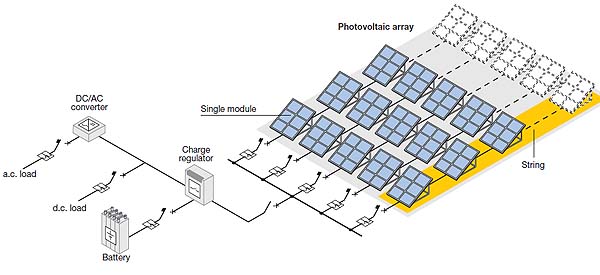
Generally speaking, a stand alone photovoltaic plant is constituted by the following devices:
- photovoltaic array: constituted by the photovoltaic cells suitably interconnected and used for the conversion of sunlight energy into electrical energy;
- charge regulator: it is an electronic device able to regulate charging and discharging of accumulators;
- accumulator batteries: they can provide power supply in case of lack of solar radiation;
- DC/AC inverter: it has the function of turning direct current into alternating current by controlling it and stabilizing its frequency and waveform.
The following figure shows the block diagram of a stand alone photovoltaic plant..
[ABB]Фотоэлектрические установки
Фотоэлектрические установки осуществляют прямое преобразование солнечной энергии в электрическую. Такие установки состоят из панелей полупроводникового материала, вырабатывающего электрическую энергию под воздействием солнечного излучения.
Фотоэлектрические установки являться частью общей энергосистемы или снабжать электроэнергией отдельную нагрузку (автономную установку).
В последнем случае в состав системы должна входить аккумуляторная батарея, обеспечивающая бесперебойную подачу электроэнергии в случае недостаточного солнечного излучения.
Основной частью фотоэлектрической установки являются фотоэлементы, изготовленные из полупроводникового материала (аморфного или монокристаллического кремния). При облучении солнечными лучами фотоэлемент генерирует максимальный ток Iмакс. при максимальном напряжении Uмакс, что соответствует максимальной мощности Wмакс..
Для увеличения выходного напряжения несколько фотоэлементов соединяют последовательно в ряд. Для увеличения тока несколько рядов соединяют параллельно.
Так, например, если один фотоэлемент может произвести ток 5 А при напряжении 35,5 В пост. тока, то для получения источника электроэнергии с током 100 А при напряжении 500 В пост. тока требуется соединить параллельно 20 рядов по 15 фотоэлементов в каждом.
Обычно автономная фотоэлектрическая установка состоит из следующих устройств:
- фотоэлектрическая батарея: состоит из соединенных между собой фотоэлементов, преобразующих солнечную энергию в электрическую;
- регулятор заряда: электронное устройство, предназначенное для регулирования заряда и разряда аккумуляторов;
- аккумуляторная батарея: обеспечивает электропитание нагрузки при недостаточном солнечном излучении.
- инвертор: преобразует постоянный ток в переменный ток стабильной частоты и формы.
На следующем рисунке показана функциональная схема автономной фотоэлектрической установки
[Перевод Интент]Русско-английский словарь нормативно-технической терминологии > фотоэлектрическая установка
См. также в других словарях:
Function object — A function object, also called a functor or functional, is a computer programming construct allowing an object to be invoked or called as if it were an ordinary function, usually with the same syntax.Function objects are unrelated to functors in… … Wikipedia
Type I and type II errors — In statistics, the terms Type I error (also, α error, or false positive) and type II error (β error, or a false negative) are used to describe possible errors made in a statistical decision process. In 1928, Jerzy Neyman (1894 1981) and Egon… … Wikipedia
Comparison of programming languages (basic instructions) — Programming language comparisons General comparison Basic syntax Basic instructions Arrays Associative arrays String operations … Wikipedia
Color BASIC — is the implementation of Microsoft BASIC that is included in the ROM of the Tandy/Radio Shack TRS 80 Color Computers ( CoCos ) manufactured between 1980 and 1991. BASIC (Beginners All purpose Symbolic Instruction Code) is a high level language… … Wikipedia
Niemann-Pick disease, type C — Classification and external resources ICD 10 E75.2 (ILDS E75.230) ICD 9 272.7 … Wikipedia
built-in type — noun A data type provided by a programming language as a basic building block, such as integer, character or Boolean, but in some languages also list, hash table or first class function. See Also: primitive type, composite type … Wiktionary
Comparison of C Sharp and Visual Basic .NET — The correct title of this article is Comparison of C# and Visual Basic .NET. The substitution or omission of the # sign is because of technical restrictions. Programming language comparisons General comparison Basic syntax Basic instructions … Wikipedia
Simons' BASIC — This product is widely, but incorrectly, called Simon s BASIC , because of confusion between the first name Simon and the surname Simons .Simons BASIC was an extension to BASIC 2.0 for the Commodore 64 home computer. Written by 16 year old… … Wikipedia
Graphics BASIC — is a third party extension to the Commodore BASIC V2.0 programming language of the Commodore 64 computer. It was originally written in 1983 by Ron Gilbert and Tom McFarlane. The program was licensed to Hesware, who briefly sold the program in… … Wikipedia
City block — For other uses, see City block (disambiguation). Diagram of an example of a rectangular city block as seen from above, surrounded by streets. The block is divided into lots which were numbered by the developer as shown in red here and as shown in … Wikipedia
Data type — For other uses, see Data type (disambiguation). In computer programming, a data type is a classification identifying one of various types of data, such as floating point, integer, or Boolean, that determines the possible values for that type; the … Wikipedia
Перевод: со всех языков на английский
с английского на все языки- С английского на:
- Все языки
- Со всех языков на:
- Все языки
- Английский
- Русский
basic function block type

18+
© Академик, 2000-2026
- Обратная связь: Техподдержка, Реклама на сайте
Экспорт словарей на сайты, сделанные на PHP, Joomla, Drupal, WordPress, MODx.